
Exercises To Improve Your Thoracic Spine Mobility
Sedentary lifestyles are an undesirable hallmark of modern society, affecting a significant proportion of the population. Prolonged sitting, (a form of sedentary behavior), has progressively become the norm with computerization in the workplace. These developments are not only detrimental to physiological health and well-being with rising levels of obesity, diabetes, and cardiovascular disease, but also musculoskeletal health. Recent research findings have found an association between prolonged sitting (>8 hours a day) and increased neck, shoulder, and low back pain. This is why posture has become such a hot topic and what are the best exercises for good versus bad posture! When we think about posture, it always brings us to thoracic spine mobility. Sedentary behaviors may induce a relatively stiff thoracic spine contributing to the dysfunction in the adjacent spinal regions. This article will provide you with exercises to improve your thoracic spine mobility!
Why Does Your Mid Back Become Stiff?
Why does this area of the spine become stiff? How do I improve motion in this area of my back? As previously discussed, prolonged positioning in a sedentary position may lead to stiffness in the thoracic spine. To make substantial and long-term improvements in mobility not only of the thoracic spine but anywhere in the body, consistency is key! Making movement a part of your daily routine will promote the long-term success of permanent improvements. Moreover, passive stretching exercises are oftentimes appropriate; however, it is very important to perform active mobility exercises within new ranges of motion in order to promote permanent changes to mobility! Habits do take time to stick. We know it is difficult to get into a routine when life presents limited time as well as other important tasks that must be done. However, these exercises to improve thoracic spine mobility may only need about 10-30 minutes maximum of your time that can easily be incorporated into daily routines! Below we will begin to highlight various exercises that will help you improve your thoracic spine mobility.
Looking For A Comprehensive Mid Back Program?
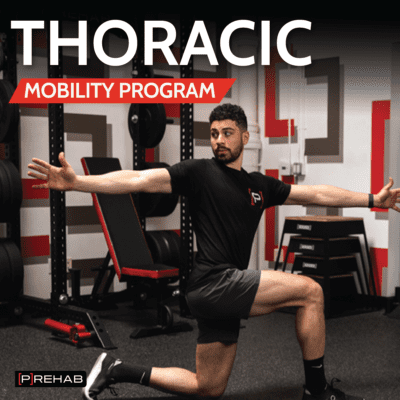
Thoracic spine mobility is a precursor to optimal neck health, shoulder health, and so much more. Yet, the average person is bound to be stiff and limited in this region and the rest of their mid-back! We can blame 21st-century workplaces and lifestyle habits, but the good thing is the thoracic spine and mid back region respond extremely well to the right dose of exercise. We've taken the guesswork out of how to improve how you feel and how well you can move! Learn more HERE.
Improve Thoracic Spine Mobility: Wall Angel
Shown here is a great exercise to improve your thoracic spine extension mobility while focusing on minimizing movement at the lumbar spine:
- Try keeping the glutes and abdominal muscles engaged to prevent excessive lordosis and anterior pelvic tilt from occurring (low back arching). If you're having difficulty recruiting your core, try this exercise.
- If you're still having trouble, take a seat and march your feet as close as you can towards your butt. This will allow you to passively take up all the joint motion from your hips and lumbar spine.
- Perform a wall angel by placing your elbows and your wrists on the wall and slowly elevating your arms until they are fully overhead, then return to the starting position and repeat for 10-15 repetitions.
4 Exercises To Improve Your Stiff Mid Back
How To Improve Your Wall Angel
Sample Thoracic Spine Mobility Overhaul Exercise
The Wall Angel is a commonly performed exercise in both Rehab and Prehab for good reason. It is a great bang for your buck exercise that addresses numerous body regions with core engagement, thoracic spine extension, scapular muscle activation, shoulder mobility, and deep neck flexor muscle activation.
If you are having a difficult time simultaneously keeping your elbow and wrist against the wall, here are two stretches you can perform prior to performing your next wall angel!
- Pec Stretch + Lift-Off: First focus on pushing into the wall with the opposite hand to maximize this passive stretch. Turn this into an end-range hold by lifting your wrist off the wall for a 5-second count for 3 repetitions. Push deeper into the stretch between each rep.
Note: Try to keep the front of your shoulder stable against the wall to avoid excessive anterior humeral translation, Anterior humeral translation is when the head of your shoulder joint begins to move forward within the joint, which may lead to increased stress on the structures around this area of the joint space as well as potential discomfort in the shoulder.
- Modified Child's Pose + Lift Off: Hip hinge until you feel an adequate stretch. At this end-range position, hover your hand just a bit off of the wall. This will look very similar to the Y exercise. Perform this for a 5-second count of 3 repetitions per side. Push deeper into the stretch between each rep.
Note: You can do this in a child's pose position, however doing it against the wall allows you to push into deeper shoulder flexion.
Why Thoracic Spine Extension Matters
Excessive thoracic spine flexion—also known as excessive kyphosis—may contribute to issues up the kinetic chain to the shoulders and neck, or down the kinetic chain to the lower back. With the hunched-over position that most of us remain in throughout the day at our places of work, our joints and soft tissue often adapt to this flexed posture, limiting us from getting the 25 degrees of thoracic spine extension that is considered the “norm.” When someone lacks thoracic spine extension, they will often compensate with lumbar spine (lower back) extension. With a repeated poor movement pattern of compensated lumbar spine extension, an individual may develop extension-sensitive low back pain. Try out this exercise to improve your thoracic spine mobility!
LISTEN: How To Improve Your Posture
Thoracic Spine Mobility Using A Foam Roller
Sample Thoracic Spine Mobility Overhaul Exercise
- Place the foam roller perpendicular to your spine onto a segment that you want to work on (personally I like to work from bottom to top).
- While grabbing onto a stick/pipe, elevate your arms as far back as you can in an attempt to touch the floor. This movement is very similar to a wall angel.
- Spend a few repetitions on each segment-then move up toward the next.
Some tips...Don’t allow your but to come off the floor or your ribs from flaring out as this is typically due to compensation from your low back!
A more aggressive way to perform this exercise is by using an external load of weight as shown here. This will make the stretch more passive and less active.
Why Rotation Matters For Your Mid Back
Your thoracic spine, also known as your mid-back, is comprised of 12 vertebrae (T1-T12) and is responsible for about 35 degrees of rotation to each side. This number is just a norm and can vary from person to person. The amount of rotation you have depends significantly on your activity. For example, if you play golf or baseball you may have more rotation to one side than the other. Shown here are three great exercises to improve your thoracic spine mobility.
Thoracic Spine Active Rotation Exercise
Exercise 1️⃣ ✅Start in a 1/2 kneeling position with a ball between your inner leg and the wall. This will ensure you DON'T cheat with any hip motion!
✅Try to rotate with your hand all the way around and back
✅Progression: Keep your hand away from the wall the entire time
Exercise 2️⃣ ✅In half-kneeling - Keep both hands behind your head
✅Thoracic spine around the world against the wall
✅Rotate all the way around and come back, try to challenge yourself by keeping the elbow away from the wall.
❌AVOID side-bending in the opposite direction, as this is a compensation for the movement you should be doing. You may be asking, what is the difference between this and the open book exercise? The answer is that this particular exercise requires more active range of motion!
Quadruped Thoracic Spine Rotation
Sample Thoracic Spine Mobility Overhaul Exercise
Here is a nice alternative position on your hands and knees to work on thoracic rotation mobility if the half-kneeling position aggravates your knees or is too hard for you to balance with.
- Begin with a rock back to allow your lumbar spine to go into flexion in order to lock out your lower back. This allows the motion to come primarily from the thoracic spine.
- Rotate with one hand as far as you can while keeping your arm in contact with the floor.
- An alternative way of performing the exercise is shown with the hand on the head. Focus on opening up your chest to the wall you are rotating towards. Focus on moving ONLY at the thoracic spine.
Closing Thoughts
The thoracic spine is an area where movement can often be neglected, which can lead to decreased mobility in this area, problems at the neck or low back, or just limitations in overall functional mobility and how well you can move. This article has highlighted a few different ways to decrease thoracic spine stiffness and potentially mitigate the risk of neck and low back pain. By incorporating a few of these exercises into your exercise routine, you can improve your thoracic spine mobility! This article primarily included exercises to improve your thoracic spine mobility into extension and rotation, we hope you enjoyed it! Work positioning and set-ups are a hot topic that has been recently been debated. To learn more about this, read our blog on the perfect work desk posture.
The Ultimate Program To Improve Your Mid Back Mobility
When we think of the thoracic spine one word comes to mind; neglect. Thank you for striving to replace that word by completing this program! The thoracic spine is structurally designed to allow mobility to happen. If this area becomes neglected, the lower back and shoulders can become angry neighbors. The solution becomes restoring peace in the neighborhood by owning thoracic mobility. The block party is 8 weeks away and you are hosting the thoracic spine, get ready to impress your neighbors!
REFERENCES
About The Author
Arash Maghsoodi, PT, DPT, CSCS
[P]rehab Co-Founder & Chief Marketing Officer
 Arash Maghsoodi received his Doctorate in Physical Therapy from the University of Southern California. For his undergraduate studies, he attended San Diego State University and studied Kinesiology. After sustaining a career-ending ankle sprain while playing collegiate soccer, he realized how disabling and life-altering injuries can be. Arash currently resides in beautiful Santa Monica, California. His clinical experience is primarily in the orthopedic and sports setting. He has treated a wide variety of conditions ranging from the post-operative individual to the professional athlete. Arash is keeping the family legacy of becoming a physical therapist, as his mother is a practicing clinician of 30 years in the Orange County area.