
You are NOT your MRI – MRIs for Low Back Pain
Mike had the unique opportunity to spend 4 months treating in China. Sadly, the people there have an extremely low level of education and understanding of their health. Every day in the clinic, we battled not just construed cultural enigmas, "my back hurts because of the cold wind", but also improper education & advice, "my doctor told me if I do anything more vigorous than walking my nerve will impinge and I will be paralyzed". One of the biggest reasons why we embarked on the [P]Rehab mission in the first place was to inject some truth and science into the fitness and health industries. Proper education on your movement system, why you experience pain, and self-management strategies can go a really long way in making this world a much better and happier place. Education is power. Let us educate you on MRIs for low back pain and why you should always take medical imaging with a grain of salt!
YOU ARE NOT YOUR MRI!
MRIs for low back pain, especially when it comes to musculoskeletal low back pain, are not just extremely expensive and more often than not unwarranted - they can actually cause more harm than good. If you and I (both healthy individuals) had an MRI, I can almost guarantee our results would AT A MINIMUM read something along the lines of "mild degenerative changes at L4-5". Or even "slight disc bulge at L3-4". Does that mean you can't walk and your back aches for days? No. If your back does start aching, does it mean it's from your "disc bulge"? Probably not. What is more likely to be the culprit is you slept in the wrong position one night or you didn't properly hip-hinging while deadlifting yesterday. Just because there are "findings" on an MRI does NOT mean that’s the cause of your low back pain.
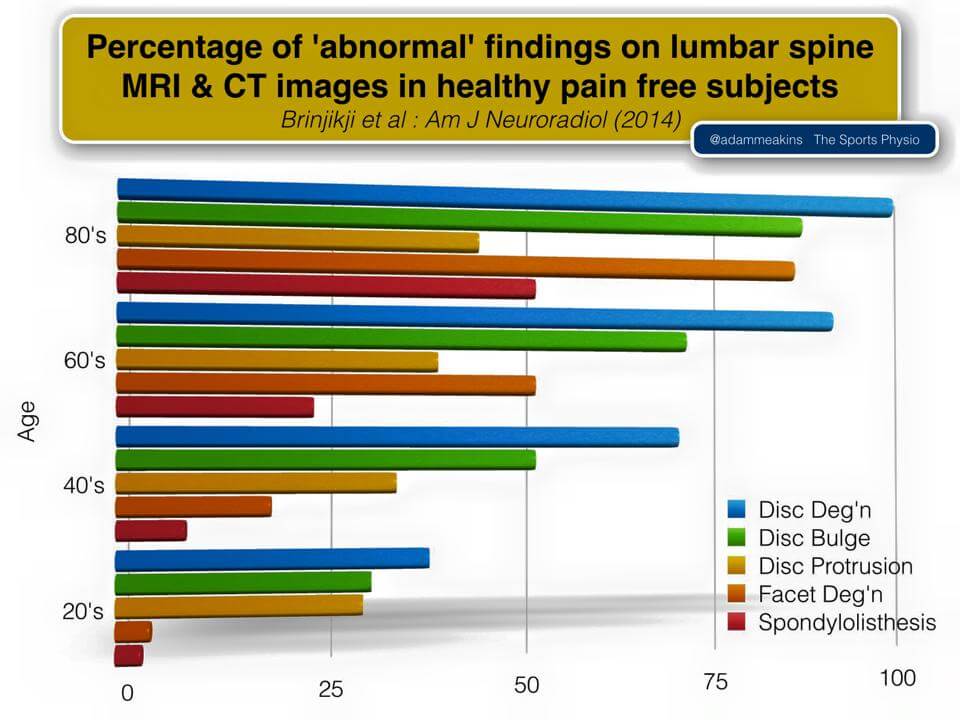
I hate to break it to you, but that MRI shouldn't dictate or influence ONE BIT how your physical therapist manages your pain. Because guess what, you and joe schmo can have the same exact MRI findings, but Joe could be in 10/10 pain while you feel like you could do a triathlon. A physical therapist will treat YOU And YOUR clinical presentation. What things make YOU feel worse or better? What impairments do YOU have? What movements do YOU need? Not what an image shows, as everyone's MRI will undoubtedly show something.
Our Program Is Designed For You To Treat Your Low Back Pain!
Conservative treatment for low back pain has been shown to be superior to other interventions such as injections, medications, or surgery. No matter how long you have suffered from back issues, it is never too late to start feeling better. We get it, we have dealt with low back issues too! This program is a physical therapist developed, step-by-step program that blends exercise science, current evidence, our clinical expertise, and our personal experiences to provide you with the ultimate solution! Learn more HERE!
You Have an MRI & A Herniated Disc, Now What?
Spine MRIs: There Is A Time And Place
Now, don't get us wrong - MRIs for low back pain definitely have a time and place and are a useful tool in ruling out the big bad uglies like tumors or true spinal cord compression. However, many people run to get an MRI the moment they are in a little bit of discomfort. It's ruining our healthcare system - financially and socially.
LISTEN: CASE STUDY OF DISC HERNIATION WITH PREHAB
And when we healthcare providers fail to educate those on their findings, we're failing our patients. Don't the words "degeneration" or "disc bulge" sound daunting, definitely if you're a relatively fit 35-year-old! If we don't educate the public on radiographic/MRI findings, it's natural to feel scared, and become fixed on your imaging and consequently loose up. It's a downward spiral for many.
This is why MRIs for low back pain - without proper education - can cause more harm than good.
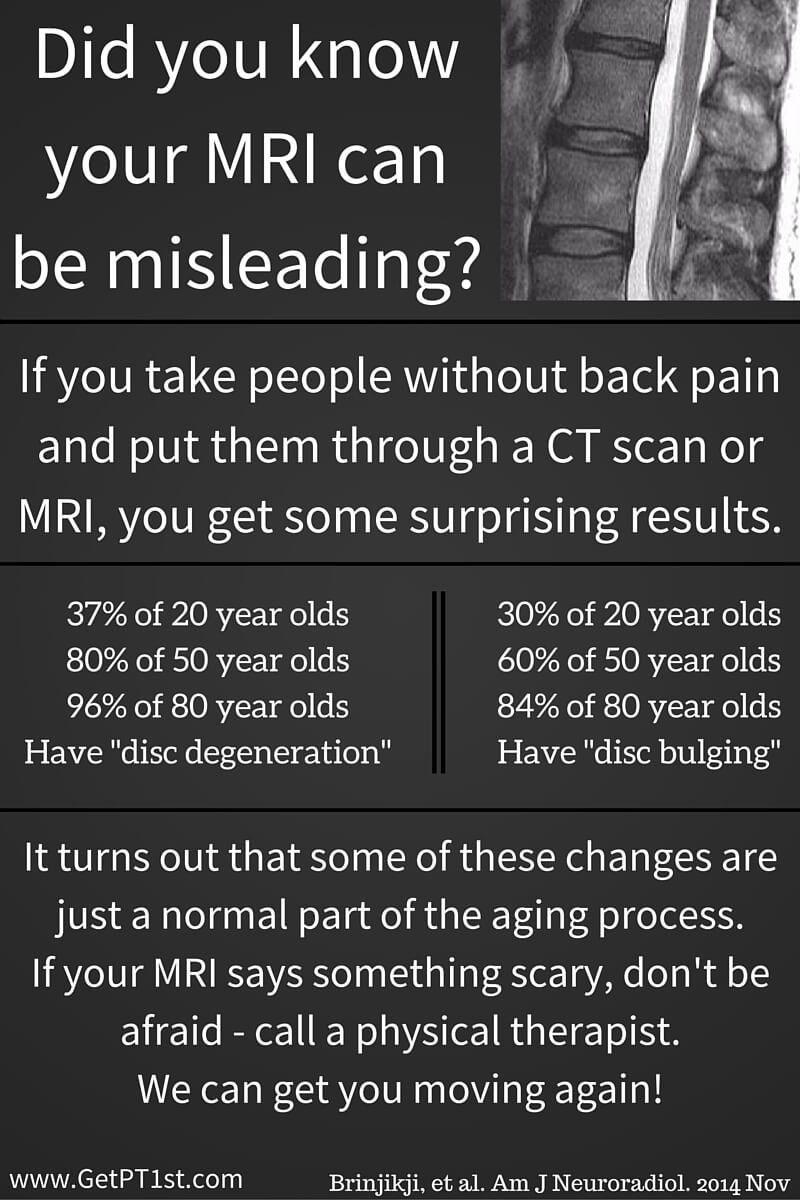
To sum it up, here's a direct quote from a major 2014 review by Brinjikji et al: "signs of degeneration are present in very high percentages of healthy people with no problem at all. Many imaging-based degenerative features are likely part of normal aging and unassociated with pain.” Pain is an enigma that is not fully understood. We currently have been providing more education to the public about what pain is, where it comes from, and how you can understand it better!
No Pain No Gain, Right? Not Exactly
UPDATE! We recently have dedicated a new blog post to the topic of "No Pain, No Gain". This is because oftentimes, individuals may be afraid to move even if they are having the slightest amount of pain. What we discuss in this article is that there is more recent evidence supporting a new model for pain, and that with certain conditions, it is actually OK to work through mild symptoms of discomfort when overcoming an injury! As we have harped on, education is crucial. We want to educate the public on what normal sensations are during exercise, and what may be abnormal. We will have discomfort here and there, and we are here to tell you that is Ok!
READ: IS NO PAIN NO GAIN TRUE?
Physical Therapists and Direct Access
An excellent tool that physical therapists are able to utilize is direct access! This simply means that if you sustain an injury, say you tweak your low back mowing your lawn for example. You can search for a trained Doctor of Physical Therapy that practices close to your home, call that specific office, and schedule an evaluation, WITHOUT A SCRIPT from a healthcare provider! This is beneficial for a number of reasons:
- Allows you to save time after an injury and be seen quicker, which often leads to a more positive prognosis and outcome
- Saves money, as often, an individual may pay for imaging, a visit to the emergency department, and even their family physician, all before seeing a physical therapist!
- Decrease the economic burden on the healthcare system: The bouncing around from all avenues of healthcare increases the number of visits per episode of care, and as a result, MONEY!
As Doctors of Physical Therapy, we have received a thorough education that allows us to decipher if someone presenting with an injury is musculoskeletal in nature (bone, joint, soft tissue, etc.), or an underlying condition that requires further consultation with a different healthcare provider. Furthermore, oftentimes if we can catch injuries quickly, we can help rehab those people quicker and get them back to their prior level of function! It was when people leave injuries unaddressed, that they become chronic, worse, and harder to overcome.
Closing Thoughts
MRIs for low back pain. Are they always needed? If I tweaked my back, is this the only way I will know what is wrong with me? The first thought after an injury is, "O my gosh, what is wrong with me??". I NEED a diagnosis. Yes, this is common, we as humans want answers. We want to know what is wrong with our bodies, and we have a right to know. However, oftentimes, with imaging specifically, this may implant fear and negative thoughts into our head, making us think there is something more that is wrong with us when in all actuality, many imaging findings are NORMAL! As we age, there are normal changes that happen within our bodies. So just because you may hear words such as "arthritis, stenosis, degeneration, or bulging discs" for example, this does not always correlate with pain or a clinical presentation! Keep this in mind if you do happen to have images done after an injury, and do not be afraid to ask questions to your healthcare provider about what is normal and what may actually be contributing to your pain!
Looking For Low Back Relief?
The low back is the centerpiece of our movement foundation and is the most adaptable and resilient area of the movement system. Since it takes on so many responsibilities it can at times become overwhelmed and request a change be made. Those requests tend to say: "Can you use your hips more?" and "Can you build up more core strength for this activity?" After this program, your back will be happy to know that these requests have been attended to! Learn more HERE!
References
About The Author
Michael Lau, PT, DPT, CSCS
[P]rehab Co-Founder & Chief Product Officer
 Michael was born and raised in Northern California but now currently resides in Sunny SoCal ever since attending the University of California, Los Angeles as an undergraduate majoring in physiology. After his undergraduate studies, he received his Doctorate in Physical Therapy from cross-town rival the University of Southern California. As a licensed physical therapist with a strong background in strength and conditioning, Michael likes to blend the realms of strength training and rehabilitation to provide prehab, or preventative rehabilitation, to his patients. A common human behavior is to address problems after they become an issue and far often too late, which is a reactionary approach. He believes the key to improved health care is education and awareness. This proactive approach-prehab-can reduce the risk of injuries and pain in the first place. He is a huge proponent of movement education and pain science. Clinically, he has a special interest in ACLR rehab and return to sport for the lower extremity athlete.