
Stork Exercise Variations For Gluteus Medius Activation
The stork exercise (also referred to as the captain morgan exercise), is one of our all-time favorites for gluteus medius activation and neural priming prior to exercise. Not only is it already in a functional weight-bearing position, but you can ramp up as much activation as you want by pushing harder and harder into the wall. Follow along in this article as we show you stork exercise variations for gluteus medius activation, as well as other wall-supported hip exercises!
How To Properly Execute The Stork Exercise
There are a couple of keys to properly executing the stork exercise:
- The stance leg (leg on the ground) is the one doing almost all of the work
- Drive your foot into the ground and squeeze your glutes to push into the wall
- Think of your hips as a tetter-totter. You'll want to drive your hip that is on the wall up and into the wall as well. This will cause the hip on your stance leg to be relatively lower than the one in the wall.
In terms of programming, the stork exercise is excellent as a glute activation warm up prior to getting into my more dynamic exercises like jumping. Aim for 2-3 sets of 30-45s holds. That's all you need! Shown below are a couple of our favorite variations of the exercise, from easiest to most advanced. Give them a shot!
READ: MUSCLE ACTIVATION EXERCISES PRIOR TO TRAINING
The Stork Exercise a.k.a The Captain Morgan

This stork exercise is one of our favorites for improving hip stability. The Glute Med wall lean will mimic the single-leg stance required for functional movements such as walking, ambulating on stairs, or running. When the Gluteus Medius is weak it can lead to injuries such as IT band syndrome, medial knee pain, trochanteric bursitis, low back pain, Achilles tendinopathy, shin splints, and plantar fasciitis. (Ireland et al. 2003, Robinson et al. 2007, Cichonowski et al. 2007).
For this exercise, start with your feet about hip-width apart. With your knee closest to the wall elevate and push your knee into the wall so that your hip is not touching the wall. Avoid leaning over towards your stance limb, this is tricky because at the same time you want to avoid leaning too far towards the wall allowing your shoulder to touch the wall. Basically, allow your trunk to remain in the neutral position you would be in if you were to stand. The further you move your stance leg away from the wall, the more difficult this exercise will get. Although you are also strengthening the leg that is pushing up against the wall, the stance limb is the one doing most of the work and it should fatigue first! Go ahead and try this out, it is much more difficult than it looks!
Dominate Storks, Single Leg Movements, and Overall Hip Health!
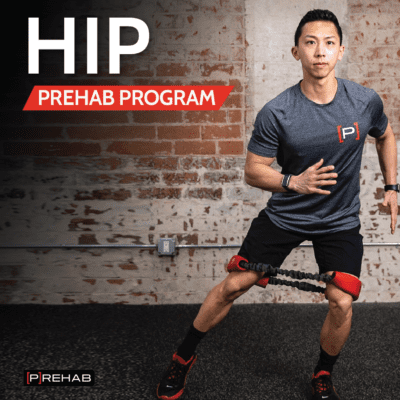
Looking to elevate your hip gains? This program is perfect for you! The Hip [P]Rehab Program is a physical therapist developed, step-by-step program that teaches you how to optimize your hip health. This 3-phase program will expose you to various hip and lower body strengthening and stabilization exercises supported by science. This program will bulletproof your hips for anything life throws at you! Learn more HERE!
Storks for Runners
Once you can properly perform the stork, try implementing a little bit of sport-specific movement into the exercise! Here, I'm trying my best to replicate the biomechanics at the hip for a runner. The glutes are our primary controller of frontal plane motion in running. During loading response (when you strike the ground), your glutes need to eccentrically control your femur moving into flexion. As you progress over your foot, it requires the glutes to concentrically move the femur into extension. Just have fun with movement!
LISTEN: RUNNERS KNEE WITH [P]REHAB
Standing Clam - Open Stance

Get a band set-up around and above your knees, then get a ball set-up between one knee and the wall while holding a squat position with the side further away from the wall in an open stance position. While maintaining pressure into the ball against the wall so that it doesn’t drop, perform a clam exercise by rotating the hip/knee out on the side that is not touching the ball. Go as far as you can, hold for a moment, then slowly come back in and repeat. You will feel the outside of your hip muscles and butt muscles working on both sides, you may also feel your thigh muscles working too. Do not let the ball drop, do not arch your back, and maintain a good squat position.
Don't Make These Mistakes With Your Banded Glute Exercises
Standing Clam - Wall Supported

Sample Hip [P]rehab Program Exercise Video
Get a band set-up around and above your knees, then get a ball set-up between one knee and the wall while holding a squat position. While maintaining pressure into the ball against the wall so that it doesn’t drop, perform a clam exercise by rotating the hip/knee out on the side that is not touching the ball. Go as far as you can, hold for a moment, then slowly come back in and repeat.
You will feel the outside of your hip muscles and butt muscles working on both sides, you may also feel your thigh muscles working too. Do not let the ball drop, do not arch your back, and maintain a good squat position.
Closing Thoughts
The stork exercise is an excellent way to prime your hips prior to more functional movements. Mix it up and add in variations as you become more comfortable with this movement. Be intentional with your muscle contractions and really focus on that glute activation! As you first start this exercise, it is often beneficial to focus on prolonged contractions to gain the mind-body connection, thus enhancing the ability for that muscle to contract more readily with functional activities.
Take Ownership Of Your Hip Health
To go from stepping to sitting we can thank the 27 muscles that cross the hip joint for their work. After thanking them, we should also thank your core, knees, feet, and really the rest of your movement system as they work together on a team to create movement. Perhaps, the best way to thank them is by giving them what they desire: strength and power!
About The Author
Michael Lau, PT, DPT, CSCS
[P]rehab Co-Founder & Chief Product Officer
 As a licensed physical therapist with a strong background in strength and conditioning, Michael likes to blend the realms of strength training and rehabilitation to provide prehab, or preventative rehabilitation, to his patients. A common human behavior is to address problems after they become an issue and far often too late, which is a reactionary approach. He believes the key to improved health care is education and awareness. This proactive approach-prehab-can reduce the risk of injuries and pain in the first place. He is a huge proponent of movement education and pain science. Clinically, he has a special interest in ACLR rehab and return to sport for the lower extremity athlete.