
 Taryn was born and raised in Maine and still resides there with her boyfriend and son. Taryn received her Doctorate in Physical Therapy from Husson University in 2010, and also carries a Bachelors in Kinesiology and Human Movement Science. She is a Certified Lymphedema Therapist, a Certified Crossfit Level 1 Trainer, and a NASM Certified Nutrition Coach. Taryn has 10+ years of experience in many different realms of PT, from the young athlete to the geriatric patient. Taryn considers herself a ‘lifelong learner’. She has special interests in oncology care and breast health, dry needling, and Crossfit training. In her free time, Taryn enjoys fitness, spending time with her family, continuing education, writing and reading, and is very excited to be a part of The [P]Rehab team to educate and empower others to take control of their own health and wellness.
Strengthening Exercises For Pull Ups
Remember being a kid in elementary school and having to perform various tests of fitness? Usually, these tests involved running a pre-determined distance, sit ups, push ups, maybe some baseline flexibility testing….and, of course, THE PULL UP! If you are anything like me, this was the most dreaded portion of the test. I couldn’t do a pull up if my life depended on it! In fact, I couldn’t perform a single strict pull up until I was 30 years old. Ready to achieve your first one? Follow along for the best strengthening exercises for pull ups!
Let's Get Pulling!
Many people like me, whether is it elementary school revenge, or just the fact that we want to be stronger and accomplish this seemingly impossible task, yearn to get their first strict pull up. In this article, we will discuss specific strengthening exercises for individual muscle groups to assist you in getting your chin over that bar for the first time. We will also discuss the importance of "practicing how you play" with specific vertical pulling drills that will translate nicely to an actual pull up!
Achieve Fitness Milestones Like Your First Pull-Up With Our Program!

WHICH MUSCLES HELP YOU ACHIEVE A PULL UP?
In order to know how to strengthen our upper body for pulling motions, we must first establish which actual muscles do the work when performing a pull up. There are several muscle/muscle groups involved in this process.
LATS (Latissimus Dorsi)
The latissimus dorsi, more commonly referred to as “the lats”, are large muscles of our back that attach to our arms. Primarily, they exist to connect our arm to our vertebral column, and often look like “wings” extending from a person with excellent muscular development in this area. They help to protect and stabilize our spine while providing strength in the shoulders and back.
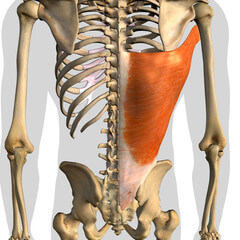 From Adobe Stock
The lats are the primary movers when it comes to performing a pull up. For most people, this the is main focus of strengthening when we are looking to improve pull up capacity.
BICEPS (Biceps Brachii)
The biceps brachii is a large muscle on the front part of the arm, and the muscle we can visualize when asked to “flex”. There are two heads to the biceps, the short head and the long head. Both heads attach on to our scapula (shoulder blade), helping to stabilize and mobilize it. The main action of the biceps is to flex the elbow, however the biceps is also involved with shoulder flexion (raising our arm up).
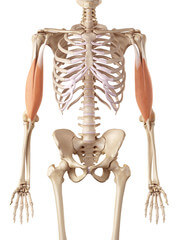 From Adobe Stock
With regard to pull ups, the biceps is a major mover for general pulling strength. When hanging from a bar with the traditional, pronated pull up, the biceps becomes a dynamic stabilizer for the shoulder and helps to protect it from injury when properly engaged. During a chin up (supinated pull up), the biceps is the primary mover due to the position of the arms and requires maximal strength and engagement.
DELTOIDS AND RHOMBOIDS
The deltoid muscle group is comprised of three individual muscles – the anterior, middle, and posterior deltoid. This group acts as a shoulder “cap”, and work to rotate and stabilize the shoulder. They also work to help a person carry heavy loads, and prevent dislocation of the shoulder when hanging from the pull up bar.
The rhomboids are a square-shaped muscle group that is located between the spine and the medial border of the scapula. They also work for scapular control and stabilization. Below is an image of the rhomboids.
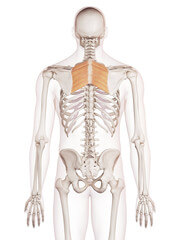 From Adobe Stock
CORE
Wait, aren’t pull ups an upper body pulling movement? How does the core come into play? The core, collectively, our ‘midsection’, contracts during a pull up to help translate energy and power into our upper body. We need to create tension in our lower body and core so that it is stable when we are pulling with our upper body.
Looking for some more core exercises? Read this article below!
READ: HOW TO TRAIN YOUR CORE!

DOES GRIP OR HAND ORIENTATION MATTER?
In the traditional pull up, the knuckles are typically faced outward (pronated grip), versus a chin up, in which the knuckles are faced inward (supinated grip). Different grip orientations for pulling motions 'turn on' different muscular groups as you are performing the movement. So, it depends on what you are trying to achieve! Research has shown that using rotating handles during pull ups or a pronated grip during a lat pull down exercise results in the greatest lat activation (1). Unsurprisingly, there was increased EMG activity in the biceps brachii and pectoralis with the supinated (chin up) grip. There was no demonstrated difference between varying grip WIDTHS on the bar for pull ups, chin ups, or lat pull downs in terms of lat activation. (1)
So again, it depends on what your goals are and what muscle groups you are trying to strengthen! As stated, both the lats AND the biceps are major movers when it comes to strengthening for strict pull ups, so it is recommended to have a varied training routine in order to maximize muscular gains for overall pulling strength.
Scapular Routine To Improve Your Pull Up Game!
Podcast Episode On Pull Ups
If you are short on time to get through this blog, or are more of an auditory learner, no worries! Listen to our awesome podcast episode as Dillon dives into the pull up!
LISTEN: HOW TO ACHIEVE YOUR FIRST PULL UP
SO, WHAT EXERCISES DO WE DO TO IMPROVE PULL UPS?
Now that we know what muscles need to be trained to improve our pull ups, let’s get to work! Outlined here are some exercises that can be used to train toward getting your first pull up, or improve your capacity if you are already performing strict pull ups.
LATS
Seated Lat Pull Downs

Prone Lat Pull Down with Band

Table Top Lat Pull Over

BICEPS
3 Way Banded Bicep Curls

Supported or Unsupported Chin Ups

DELTOIDS AND RHOMBOIDS
Deltoid Press – 3 Way

Looking for more pushing exercises? Check this out!
Bent Over Barbell or Dumbbell Rows

Sample [P]rehab Fitness Gym Edition Exercise
Banded Face Pulls

CORE
Hollow Hold

Sample [P]rehab Fitness Gym Edition Exercise
Arch Hold (Superman)

SPECIFIC VERTICAL PULL EXERCISES
Aside from building strength in individual muscular groups, it is important to train vertical pulling strength when training for pull ups. Research states that pulling vertically activates 80% of our max velocity and strength for the shoulders muscles and 50% of our max activation at the elbow. (2) That's a great way to get nice strong shoulders!
A pull up, by nature, is a vertical pull of a person’s body weight, so training in this position translates nicely to the stimulus we are trying to achieve, and should be included in a pull up training program.
*Note: Before hanging from a pull up bar, it is important to ensure that you are ready to do so safely.
Here are some vertical pulling exercises that will help you get that chin over the bar!
Scapular Pull Ups

Pull Up - Band Assist
Closing Thoughts
Whether you are looking to get your first strict pull up, or looking to build capacity to add more volume of strict pull-ups to your routine, it is important to build BOTH the individual muscle groups activated during the pull up motion as well as building overall vertical pulling strength. Having enough strength and stability around the shoulder is needed to safely hang from a pull up bar to prevent injury. And of course, practicing how we play (specifically drilling vertical pulling motions), will also for our skill transfer to the perfect pull up!
Learn How To Train For Longevity With Our Program
References
- Leslie, Kelly. L. M. BSc (Hons); Comfort, Paul MSc, CSCS*D The Effect of Grip Width and Hand Orientation on Muscle Activity During Pull-ups and the Lat Pull-down, Strength and Conditioning Journal: February 2013 - Volume 35 - Issue 1 - p 75-78 doi: 10.1519/SSC.0b013e318282120e
- Antinori, F & Felici, Francesco & Figura, F & Marchetti, M & Ricci, B. (1988). Joint moments and work in pull-ups. The Journal of sports medicine and physical fitness. 28. 132-7.
About The Author
Tayrn Everett, PT, DPT, CLT, CF-L1, CNC
[P]rehab Writer & Content Creator